
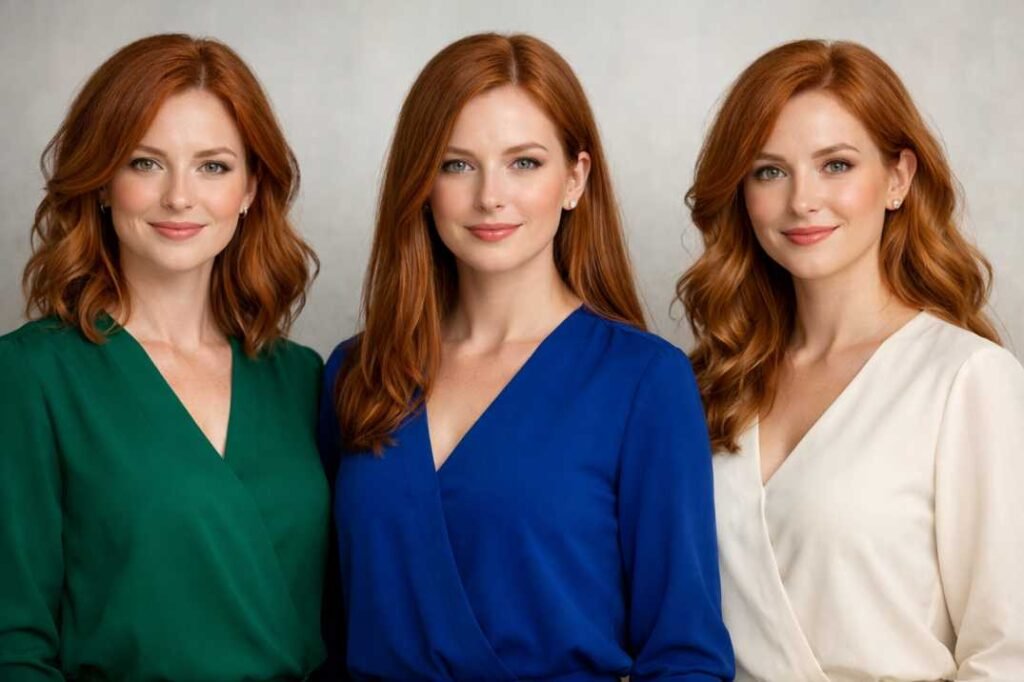
This isn’t about following rigid rules. It’s about understanding what typically works so you can experiment confidently. Red hair is distinctive, and the colors you pair with it should enhance that distinction rather than fight against it.
Whether you’re building a new wardrobe from scratch, shopping for a special occasion, or just tired of standing in your closet wondering what actually looks good—this guide breaks it all down.
Key Takeaways for Redheads Choosing Colors
- Undertones shape everything – Your skin’s undertone determines which colors harmonize with your complexion
- Green and teal are reliable winners – These shades complement red hair without competing for attention
- Individual factors matter – Eye color, hair shade, and skin tone all influence your ideal palette
- “Safe” colors can backfire – Black and gray require more thought than you’d expect
- Bold choices often work – Jewel tones and unexpected picks can be surprisingly flattering
- Seasons shift your options – Summer palettes differ from winter ones
- Context matters – Professional settings call for different approaches than weekend wear
Understanding Your Unique Color Profile
Here’s what most style guides skip over: not every redhead shares the same coloring. You’ve probably noticed this yourself. Some redheads absolutely glow in warm oranges and rusts, while others look completely washed out in anything remotely peachy. The difference comes down to undertones—the subtle hue beneath your skin’s surface that shapes how colors interact with your complexion.
Identifying Your Skin Undertone
Your undertone falls into one of three categories: warm, cool, or neutral. Most redheads lean warm or neutral, but cool-toned redheads definitely exist—particularly those with pink-based fair skin or ashy strawberry blonde hair.
The simplest test involves checking your wrist veins in natural daylight:
- Find a spot with good natural lighting—near a window works well
- Look at the veins on the inside of your wrist
- Note the predominant color you see
- Greenish veins typically indicate warm undertones
- Bluish-purple veins suggest cool undertones
- A mix of both points toward neutral undertones
Another helpful indicator is how your skin reacts to sun exposure. Warm-toned redheads often develop golden or peachy tones when tanned (though burning is more common for most redheads). Cool-toned individuals tend toward pink when they catch some sun.
How Eye Color Influences Your Palette
Eye color creates a secondary consideration that many redheads overlook when choosing clothing colors. The interplay between your hair, eyes, and outfit colors can either create beautiful harmony or feel slightly off.
| Eye Color | Colors That Enhance | Colors to Consider Carefully |
|---|---|---|
| Green Eyes | Purple, plum, warm bronze, forest green, burgundy | Bright green (can appear too matchy) |
| Blue Eyes | Warm earth tones, coral, teal, copper shades | Cool blues (may compete with eye color) |
| Hazel Eyes | Olive, burgundy, gold, emerald, chocolate brown | Muddy or grayish browns |
| Brown Eyes | Rich jewel tones, cream, navy, deep purple | Washed-out neutrals |
Green-eyed redheads typically fall into what color analysts call an “autumn” palette—warm, earthy, and rich. Blue-eyed redheads often straddle autumn and spring categories, which actually gives them more flexibility across both warm and cooler tones.
Colors That Consistently Flatter Red Hair
Let’s get into specifics. These are the shades that work reliably across different redhead types, skin tones, and occasions. Think of them as your wardrobe foundation—the colors you can grab without second-guessing.
Green: The Undisputed Champion
There’s solid reasoning behind why virtually every stylist recommends green for redheads. On the color wheel, green sits directly opposite red, creating what designers call “complementary contrast.” This opposition actually produces visual harmony—the colors enhance each other rather than fighting.
But not all greens perform equally. The shade matters tremendously:
- Emerald green – Universally flattering; works across all redhead types and most occasions
- Forest green – Particularly stunning on auburn hair; creates sophisticated depth
- Olive green – Excellent for casual, everyday wear; relaxed without being boring
- Sage green – Softer option that works well for very fair complexions
- Hunter green – Rich middle ground between emerald and forest
- Jade – Adds brightness while maintaining green’s natural compatibility
“Teal deserves its own spotlight. This blue-green hybrid works on practically every redhead I’ve dressed. It’s close enough to green to complement the hair while adding enough blue depth to prevent any ‘Christmas tree’ associations.”
— Personal stylist perspective
If you’re building a capsule wardrobe and want just one “safe” color to invest in heavily, teal or emerald should top your list. They transition smoothly from casual to professional to evening settings.
Blue: More Versatile Than Expected
Blue might seem counterintuitive—it’s a cool color pairing with typically warm-toned hair—but the right blues can beautifully ground red hair’s vibrancy.
Navy blue deserves special mention. It works almost universally on redheads, pairs particularly well with deeper auburn shades, and transitions effortlessly between casual and professional contexts. A navy blazer or dress is arguably essential in any redhead’s closet.
Other blues worth exploring:
- Cobalt and royal blue – Add energy and visual interest without overwhelming your hair color
- Soft denim blue – Creates approachable, casual looks; ideal for everyday wear
- Turquoise – Bridges the gap between warm and cool tones nicely
- Powder blue – Can work on some complexions, but test it first
One caution: icy, pale blues often wash out fair-skinned redheads. If your complexion runs very light, stick with richer, more saturated blues rather than faded or gray-tinted versions.
Purple and Its Beautiful Variations
Purple creates striking contrast with red hair. The red undertones in purple shades harmonize with your hair while providing enough difference to look intentional and polished.
Purple Shades That Work:
- Deep plum – Gorgeous for evening wear; sophisticated and rich
- Eggplant and aubergine – Dramatic without being overwhelming
- Lilac and lavender – Surprisingly flattering on many redheads; softer daytime option
- Mauve – Especially lovely on strawberry blondes
- Grape – Middle-ground option between vivid and muted
Hot pink and magenta occupy a middle ground—they work beautifully on some redheads and feel too loud on others. If you’re drawn to these shades, try them in smaller doses first (a scarf, bag, or accent piece) before committing to a full outfit.
Earth Tones: Your Natural Allies
Redheads and earth tones share a natural kinship. These warm, grounded colors echo the organic warmth of red hair, creating cohesive, put-together looks without requiring complex color coordination.
The winners in this category:
- Burnt orange and rust – Like a slightly more sophisticated cousin of your hair color; creates visual continuity without matching exactly
- Mustard yellow – Rich, saturated, and wonderfully autumnal
- Camel and warm tan – Perfect neutrals that won’t compete with your hair
- Terracotta and clay – Earthy without being boring; excellent for layering
- Warm chocolate brown – Flattering on most redheads when it carries warm undertones
- Cognac and amber – Sophisticated everyday options
A word of caution: muddy olive can look drab on some complexions, and cool-toned browns often clash with warm hair. When shopping for earth tones, check whether the brown shade leans warm (reddish, golden) or cool (grayish, ashy)—warm versions almost always work better.
The Color-by-Color Deep Dive
Certain colors generate endless questions from redheads. Can you actually wear red? What about orange—isn’t that too matchy? Let’s settle these debates once and for all.
Can Redheads Wear Red?
This question comes up constantly, and the answer is a confident yes—with some strategy.
The key principle is avoiding shades that too closely match your exact hair color. If your hair is bright copper, skip orange-reds. If you’re deep auburn, avoid burgundies that duplicate your hair tone. The goal is contrast and complement, not matching.
Red shades that typically work:
- True cherry red – Different enough from most red hair shades to create contrast
- Tomato red – Works particularly well for lighter redheads
- Deep wine or burgundy – Excellent for strawberry blondes (unless hair is already burgundy-toned)
- Coral-red – Brings warmth to fair skin without clashing
- Brick red – Earthy enough to avoid direct matching for most
A practical approach: wear red as a statement piece rather than head-to-toe. A red dress paired with neutral accessories, or red shoes with an otherwise understated outfit, lets you enjoy the color without creating a “too much red” effect.
Does Yellow Suit Redheads?
Yellow divides opinion among redheads more than almost any other color. Some absolutely radiate in golden yellows; others look immediately washed out.
| Yellow Shade | Verdict | Best For |
|---|---|---|
| Mustard | Almost universally flattering | All redhead types; fall wardrobes |
| Golden yellow | Works well on warm-toned skin | Warm undertones; summer |
| Lemon yellow | Hit or miss; test first | Neutral undertones only |
| Butter yellow | Gentle enough for most fair skin | Very fair complexions; spring |
| Neon yellow | Generally avoid | Very bold personalities only |
If you’re uncertain about yellow near your face, test it as an accessory first. A yellow bag or scarf lets you gauge the effect without full commitment.
What About Brown?
Brown suits redheads beautifully—when it’s the right brown. The crucial distinction lies in undertones.
Browns that work:
- Warm chocolate brown with golden or red undertones
- Rich caramel and cognac
- Chestnut brown
- Coffee brown with warm base
Browns that often don’t:
- Cool-toned or ashy browns
- Muddy, grayish browns
- Taupe with heavy gray undertones
The warmth in your hair needs corresponding warmth in your browns. Cold, ashy browns fight against your natural coloring, while warm browns create seamless coordination.
Does Pink Look Good on Redheads?
Pink requires thoughtful selection. Because pink contains red undertones, it can either harmonize wonderfully with red hair or compete awkwardly—depending on the specific shade.
Pinks That Work
- Coral pink
- Blush pink
- Dusty rose
- Salmon
- Warm rose
Pinks to Test First
- Hot pink / magenta
- Fuchsia
- Bubblegum pink
- Cool-based pinks
- Neon pink
Generally, warmer pinks with peachy or coral undertones outperform cool, blue-based pinks. Dusty rose is particularly underrated—it’s elegant, sophisticated, and flattering on a wide range of redhead complexions.
Burgundy and Wine: The Evening Champions
Burgundy consistently ranks among the absolute best colors for redheads. This deep red-purple hybrid creates sophisticated contrast that works across most occasions—from casual brunches to formal events.
These shades particularly shine on strawberry blondes and lighter copper redheads, where the color difference is most apparent. Deeper auburn-haired redheads should check that their burgundy pieces don’t match their hair too closely, but most find these shades incredibly flattering.
The burgundy family includes:
- Deep burgundy – Classic and elegant; works almost universally
- Wine – Perfect for formal occasions and evening wear
- Maroon – Pairs well with most warm skin tones
- Oxblood – Rich, distinctive, and memorable
- Claret – Slightly brighter option for those who find burgundy too dark
Can Redheads Wear Orange?
Orange sits closest to red on the color wheel, which creates both opportunity and challenge. Done well, orange creates a sophisticated tonal look. Done poorly, it looks like you’re trying too hard to match your hair.
The solution lies in shade selection and styling:
- Burnt orange and rust work far better than bright orange
- Terracotta offers earthy sophistication without obvious matching
- Use orange as an accent rather than a main color when uncertain
- Pair with strong neutrals to break up the warmth
Avoid neon or construction-cone orange. The shades that work are muted, earthy, and sophisticated rather than bright and attention-grabbing.
Pastel Colors for Redheads
Pastels and redheads have a complicated relationship. The soft, washed-out quality of many pastels can drain color from fair skin—or can create beautiful, ethereal contrast with vivid hair.
The key is choosing pastels with enough saturation to hold their own against your hair color:
Pastels that typically succeed:
- Soft peach – Adds warmth rather than washing you out
- Dusty lavender – Provides color without competing
- Sage and mint – Green-based pastels maintain the green-red complementary benefit
- Warm blush – Gentle but present
Pastels that often struggle:
- Baby blue – Frequently looks washed out
- Pale yellow – Very hit or miss on fair skin
- Gray-based pastels – May create a faded overall look
If you love the pastel aesthetic but find them too faded on you, try mid-tone versions of the same colors. A medium sage looks much more flattering than pale sage on many redheads.
Does Beige Work for Redheads?
Beige occupies neutral territory that can go either way. Warm beiges with golden undertones generally flatter, while cool or grayish beiges may wash out your complexion.
When shopping for beige:
- Hold the fabric near your face in natural light
- Check whether it makes your skin look healthy or drained
- Look for golden or peachy undertones rather than gray
- Consider cream or ivory as alternatives if beige feels flat
Colors That Often Create Challenges
Just as certain colors consistently flatter red hair, others frequently create less favorable results. Understanding why helps you navigate these tricky shades—or avoid them entirely.
The Problem with Black
Black is complicated territory for redheads. It’s not that you absolutely cannot wear it—plenty of redheads look striking in black—but it requires more intention than it might for other hair colors.
The issue: solid black worn close to your face can create stark contrast that emphasizes any redness or unevenness in fair skin. For very pale redheads, black may create an almost harsh appearance or make the complexion appear washed out.
The key with black isn’t avoiding it entirely—it’s being strategic about where and how you wear it. Black pants, skirts, and shoes rarely cause problems. The challenge arises when solid black sits right against your face without any break or color.
Strategies for wearing black successfully:
- Add color near your face—a scarf, necklace, or colored collar creates a buffer
- Choose softer blacks or charcoal as alternatives
- Wear black on the bottom half while keeping color on top
- Mix black with colors that flatter you in the same outfit
- Consider navy as an alternative when you want a dark neutral
Gray’s Subtle Challenges
Gray presents similar issues to black, though typically less severe. Cool grays particularly tend to clash with the warmth of red hair and can make fair skin appear dull.
Better alternatives when you want a neutral gray tone:
- Charcoal with warm undertones – Rich enough to avoid the washed-out risk
- Greige (gray-beige hybrid) – Adds warmth to the gray family
- Warm taupe – Neutral but not cold
- Heathered grays – Mixed tones often work better than solid cool gray
Colors That Rarely Succeed
Some shades create issues for most redheads regardless of specific undertones or complexion:
- Neon colors – Compete too aggressively with already-vivid hair
- Cool, muddy browns – Clash with the warmth in red hair
- Heavily washed-out pastels – Can make fair skin look sickly
- Icy, very pale shades – Often unflattering on fair complexions
- Very bright orange – Creates awkward matching effect with hair
Skin Tone Variations Among Redheads
Redheads span a wider range of skin tones than many people realize. The same color that looks stunning on one redhead may fall flat on another—and skin tone explains much of this variation.
Fair Skin with Warm Undertones
This is the most common redhead combination. If you have fair skin with golden, peachy, or yellow undertones, focus your wardrobe on:
- Warm greens (olive, forest, moss)
- Earth tones and warm neutrals
- Rich jewel tones (emerald, sapphire, ruby)
- Coral and warm pink shades
- Gold and copper metallics in jewelry and accessories
Fair Skin with Cool Undertones
Less common but definitely exists among redheads, particularly those with pinkish skin or strawberry blonde hair with ash tones. Cool-toned redheads can successfully wear:
- Soft blues and blue-greens
- Rose and dusty pink shades
- Purple, lavender, and violet
- Silver jewelry (rather than defaulting to gold)
- Cool-toned grays and soft whites
Medium and Olive Skin Tones
Redheads with olive or medium-depth skin tones enjoy significantly more flexibility. These complexions can handle:
- Bold, saturated jewel tones that might overwhelm paler skin
- Vibrant colors including bright greens and rich blues
- True white (rather than needing cream or ivory)
- Wider range of earth tones including cooler browns
- Strong contrasts and dramatic color combinations
Deeper Skin Tones
Redheads with deeper complexions—whether naturally or through heritage—can embrace:
- Intense jewel tones in their richest versions
- Bold primary colors
- High-contrast combinations
- Pure white and cream equally well
- Metallics in gold, bronze, and copper especially
Very Pale Redheads
If your skin is quite pale, some special considerations apply:
Tips for Very Fair Complexions
- Choose cream and ivory over pure stark white
- Avoid extremely dark colors directly against your face
- Select colors that bring warmth and life to your complexion
- Opt for muted rather than extremely bright shades when uncertain
- Use blush and accessories to add color if an outfit feels too neutral
Color Choices for Different Contexts
Where you’re going influences which colors make sense. An outfit perfect for a casual weekend looks entirely wrong in a boardroom, and vice versa.
Building an Everyday Wardrobe Foundation
Your regular rotation should include versatile pieces in reliably flattering colors. Consider building around:
- Navy blue basics – Blazer, pants, or versatile dress
- Emerald or forest green pieces – Makes a statement while remaining wearable
- Cream and warm ivory – Softer alternative to white
- Warm brown or cognac – Leather goods, shoes, everyday layers
- At least one bold statement piece – In a color you love and feel confident wearing
- Denim – Medium to dark washes work best for most redheads
Professional and Business Settings
Workwear for redheads benefits from sophistication without flashiness:
- Navy suits and blazers work beautifully and project competence
- Emerald and deep green create polished, memorable looks
- Burgundy adds depth without being distracting
- Cream and tan serve as professional neutrals
- Charcoal offers an alternative to black in formal settings
For business casual environments, you have more flexibility to incorporate earth tones, teal, and softer colors that might feel too casual in strictly formal workplaces.
Formal and Evening Occasions
Special events call for elevated color choices. Redheads often make particularly striking impressions at formal occasions by embracing:
- Emerald green – Classic evening elegance; photographs beautifully
- Deep teal – Sophisticated and memorable
- Burgundy and wine – Rich and romantic
- Gold and bronze fabrics – Add glamour without competing with hair
- Deep plum – Dramatic and flattering
- Sapphire blue – Striking for those who can wear cooler tones
For pageants, galas, and events with professional photography, jewel tones project well under various lighting conditions. Emerald, sapphire, and deep purple create stunning stage presence without washing out under bright lights the way pastels might.
Intimate Apparel and Lingerie
For lingerie and intimate wear, consider how colors appear against your skin:
- Deep emerald and teal – Sophisticated and flattering
- Rich burgundy and wine – Classic and romantic
- Soft blush and champagne – Gentle warmth
- Classic black – Works well in smaller amounts
- Ivory and cream – Softer than pure white against fair skin
Warm tones generally flatter against skin, while deep jewel tones add sophistication. Very pale or cool-toned options may not complement fair skin as naturally.
Color Guidance for Redheaded Men
Male redheads navigate somewhat different territory than women, with different wardrobe expectations and contexts to consider.
Casual Everyday Wear
For t-shirts, casual shirts, and weekend wear:
- Forest green, olive green – Reliably excellent
- Navy blue – Clean and flattering
- Burgundy and maroon – Adds richness
- Rust and burnt orange – Works when you want warmth
- Heathered neutral shades – Often more flattering than solid cool colors
Avoid bright orange (too matchy), neon anything, and heavily washed-out pastels. For denim, medium to dark washes pair most harmoniously with red hair.
Business and Professional Attire
Suits and formal business wear for redheaded men:
| Item | Best Colors | Notes |
|---|---|---|
| Suits | Navy, charcoal, warm gray | Navy is the safest bet; deep green works for less formal settings |
| Dress Shirts | Light blue, white, cream, soft lavender | Light blue is particularly flattering |
| Ties | Burgundy, forest green, navy, gold-toned | Avoid exact hair-matching reds |
| Pocket Squares | Complementary patterns, warm tones | Opportunity to add color personality |
Overcoats and Outerwear
Investing in a great overcoat? Consider these options:
- Navy – Classic, versatile, professionally appropriate
- Camel – Warm, sophisticated, traditionally stylish
- Deep green – Distinctive while remaining tasteful
- Charcoal – Professional and grounding
- Burgundy – Bold choice that makes a statement
Avoid very bright coats unless you want maximum attention, and consider whether black creates too harsh a contrast against your hair and fair skin.
Redheads Transitioning to Gray Hair
What happens to your color palette when red hair begins transitioning to gray or silver? The shift is gradual for most, and your wardrobe can evolve alongside it.
During the Transition Phase
When red and gray blend together—often creating beautiful rose-gold or strawberry-silver effects—you can:
- Continue with your familiar warm tones
- Keep jewel tones in heavy rotation
- Start experimenting with cooler options to see how they feel
- Pay attention to which colors draw more compliments as your coloring shifts
Embracing Fully Gray or Silver Hair
Once hair becomes predominantly gray or silver, the palette shifts more noticeably:
- Cool-toned colors that never quite worked before may now flatter beautifully
- Deep jewel tones (sapphire, amethyst, emerald) gain dramatic impact
- Black often works significantly better than it did with red hair
- Pure white becomes more harmonious
- Some warm metallics may feel less naturally complementary
Many people find this transition liberating—suddenly a whole range of colors that didn’t quite work before become flattering options.
Accessorizing to Enhance Your Coloring
Accessories provide an excellent way to experiment with colors before committing to full garments. They also add personality to neutral outfits without requiring a complete wardrobe overhaul.
Jewelry Metal Choices
The metals you choose affect how finished your look appears:
- Gold – Almost universally flattering for warm-toned redheads; enhances natural warmth
- Rose gold – Lovely middle ground that echoes copper tones in hair
- Copper and bronze – Underrated options that complement red hair beautifully
- Silver – Works best for cool-toned redheads; may feel slightly off on very warm complexions
If you’ve always defaulted to silver jewelry but have warm undertones, experimenting with gold might reveal surprisingly flattering results.
Scarves, Bags, and Accent Pieces
Use accessories strategically to:
- Test new colors without major investment
- Add color to neutral outfits
- Create focal points that draw attention upward toward your face
- Tie together multiple colors in a complex outfit
A teal scarf can test whether that color family works for you. Gold-toned jewelry adds warmth near your face. Colored bags and shoes let you incorporate bolder shades without wearing them prominently.
Seasonal Wardrobe Adjustments
Your color preferences naturally shift with the seasons, influenced by both practical considerations and the changing natural palette around you.
Spring and Summer Palettes
Warmer months invite lighter, brighter options:
- Coral and warm peach tones
- Mint and sage green
- Lighter teals and turquoise
- Soft florals in warm colors
- Warm whites and creams
- Medium blues and soft denim
These lighter colors complement sun-kissed skin (or the freckles that sunshine brings to many redheads) while feeling seasonally appropriate.
Fall and Winter Depth
Cooler months call for richer, deeper shades:
- Burgundy, wine, and oxblood
- Forest green and emerald
- Rust, burnt orange, and terracotta
- Deep plum and eggplant
- Rich chocolate and cognac browns
- Navy and deep teal
There’s a reason autumn is sometimes called “redhead season”—the natural color palette of falling leaves literally mirrors the most flattering shades for red hair. Embrace it fully.
Do All Redheads Share the Same Color Palette?
The short answer: no, definitely not.
While general guidelines help, your individual coloring creates a unique combination of factors:
- Hair shade – Bright copper, deep auburn, strawberry blonde, and ginger all respond differently to the same clothing colors
- Skin tone – Fair, medium, olive, and deeper complexions all affect color interactions
- Undertone – Warm, cool, and neutral undertones shift which shades flatter most
- Eye color – Creates secondary considerations for overall harmony
- Personal style – What makes you feel confident matters as much as color theory
Two redheads standing side by side might have dramatically different optimal palettes. Use guidelines as starting points, then trust what you observe in the mirror. If something works on you—even if it “shouldn’t” according to color theory—wear it with confidence.
Building Confidence Through Color
Here’s the truth that color guides sometimes obscure: the most flattering color is the one that makes you feel genuinely good when you wear it.
Colors you love wearing give you a confidence boost that fundamentally shows in how you carry yourself. This psychological effect often matters more than whether a particular shade technically complements your undertones.
Red hair already gets attention. The colors you choose determine what kind of attention—and how you feel receiving it. The right colors turn your distinctive feature into an undeniable asset.
If you’ve always wanted to try a bold choice that this guide suggests might not work, try it anyway. You might discover it works beautifully on you specifically. Or you might confirm it’s not your shade—but now you know rather than wonder.
Fashion is personal expression. The colors you choose should reflect your personality, lifestyle, and what makes you feel like the best version of yourself. All the color theory in the world is just a tool for getting there more efficiently.
Practical Next Steps
Ready to apply these ideas? Here’s a structured approach:
- Identify your undertone using the vein test and sun reaction indicators
- Note your eye color and check the color pairings that specifically enhance it
- Audit your current closet – Which pieces consistently earn compliments? Which feel slightly “off”?
- Test new colors gradually starting with accessories before full garments
- Build a foundation of reliable colors before branching into experiments
- Photograph yourself in different colors – Sometimes cameras reveal what mirrors don’t
- Note seasonal preferences – What works in summer may shift for winter
Your red hair already tells part of your story. The colors you choose complete the picture—making you look polished, intentional, and confidently yourself.
Frequently Asked Questions
What colors should redheads avoid wearing?
Generally steer clear of neon shades, muddy browns, and colors that exactly match your specific hair shade. Icy pastels and very cool grays can wash out fair skin. However, individual factors matter experiment to find what works specifically for you.
Are there colors that work for all redheads?
Emerald green and teal come closest to universally flattering. Navy blue also works well across most redhead types. Beyond these, individual undertones and skin tones create more variation.
Can redheads wear red clothing?
Absolutely—just choose reds that differ noticeably from your hair shade. Cherry red works for many auburn redheads, while coral-red flatters copper tones. Wearing red as a statement piece rather than head-to-toe prevents any “too matchy” effect.
Does teal look good on redheads?
Teal is one of the most reliably flattering colors for redheads. Its blue-green blend complements red hair beautifully while avoiding any holiday-themed associations that pure green might create.
What colors work for redheaded men?
Navy, forest green, burgundy, and rust work excellently for casual wear. For professional settings, navy and charcoal suits with light blue or cream shirts create polished impressions.
Do redheads look good in burgundy?
Burgundy ranks among the very best colors for most redheads. It’s sophisticated, flattering across many skin tones, and versatile enough for casual through formal occasions.
What about redheads going gray?
During the transition, stick with familiar warm tones while beginning to experiment with cooler options. Once hair becomes fully silver, cooler shades and deep jewel tones often become more naturally flattering.
Is yellow a good color for redheads?
Mustard and golden yellows typically work well on warm-toned redheads. Bright lemon yellow is more unpredictable—some find it flattering while others look washed out. Test with accessories first if uncertain.
Do all redheads have the same color palette?
No. Hair shade, skin tone, undertone, and eye color all create variation. Two redheads can have substantially different optimal palettes. Use guidelines as starting points, then trust your own observation.
What jewelry colors and metals suit redheads?
Most warm-toned redheads look best in gold, rose gold, copper, and bronze metals. Cool-toned redheads may prefer silver. Jewelry in complementary colors (greens, teals, deep blues) often works well.
Does black look good on redheads?
Black can work, but requires more strategy than other colors. Add color near your face to soften the contrast, consider charcoal as an alternative, or wear black on the bottom half while keeping color on top.
What dress colors work for redheads at formal events?
Emerald green, deep teal, burgundy, and plum create stunning formal looks. These jewel tones photograph well and flatter most redhead complexions. Gold and bronze fabrics add glamour for evening events.

- 10 Best Shotgun For Home Security: Essential Insights For Buyers 2026 - February 24, 2026
- 10 Best Shotgun Ammo For Home Defense Comprehensive Buyer Insights 2026 - February 23, 2026
- 10 Best Shot Shell For Home Defense Comprehensive Product Overview 2026 - February 23, 2026